


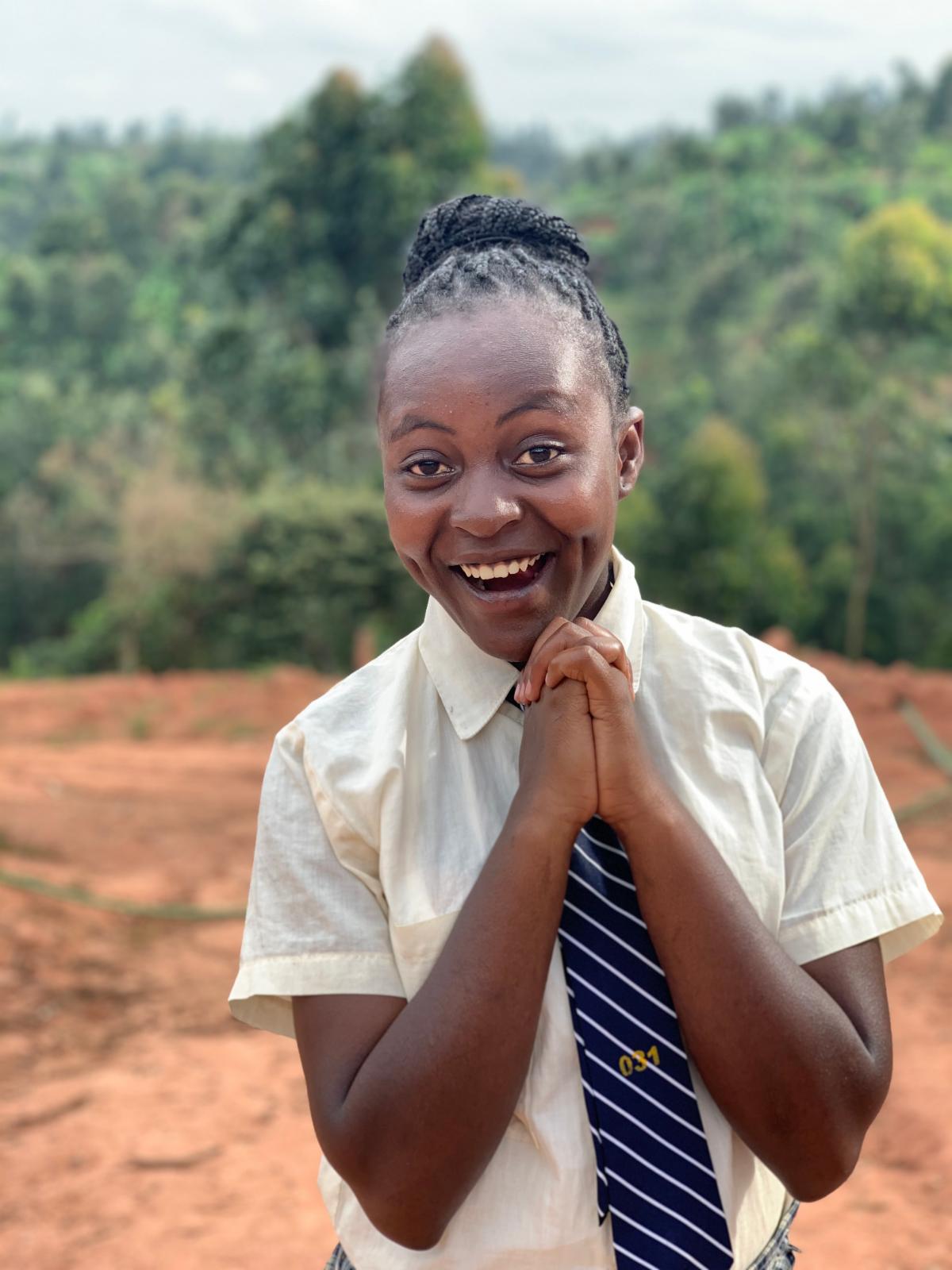
Christine on her first day of high school, January 2018
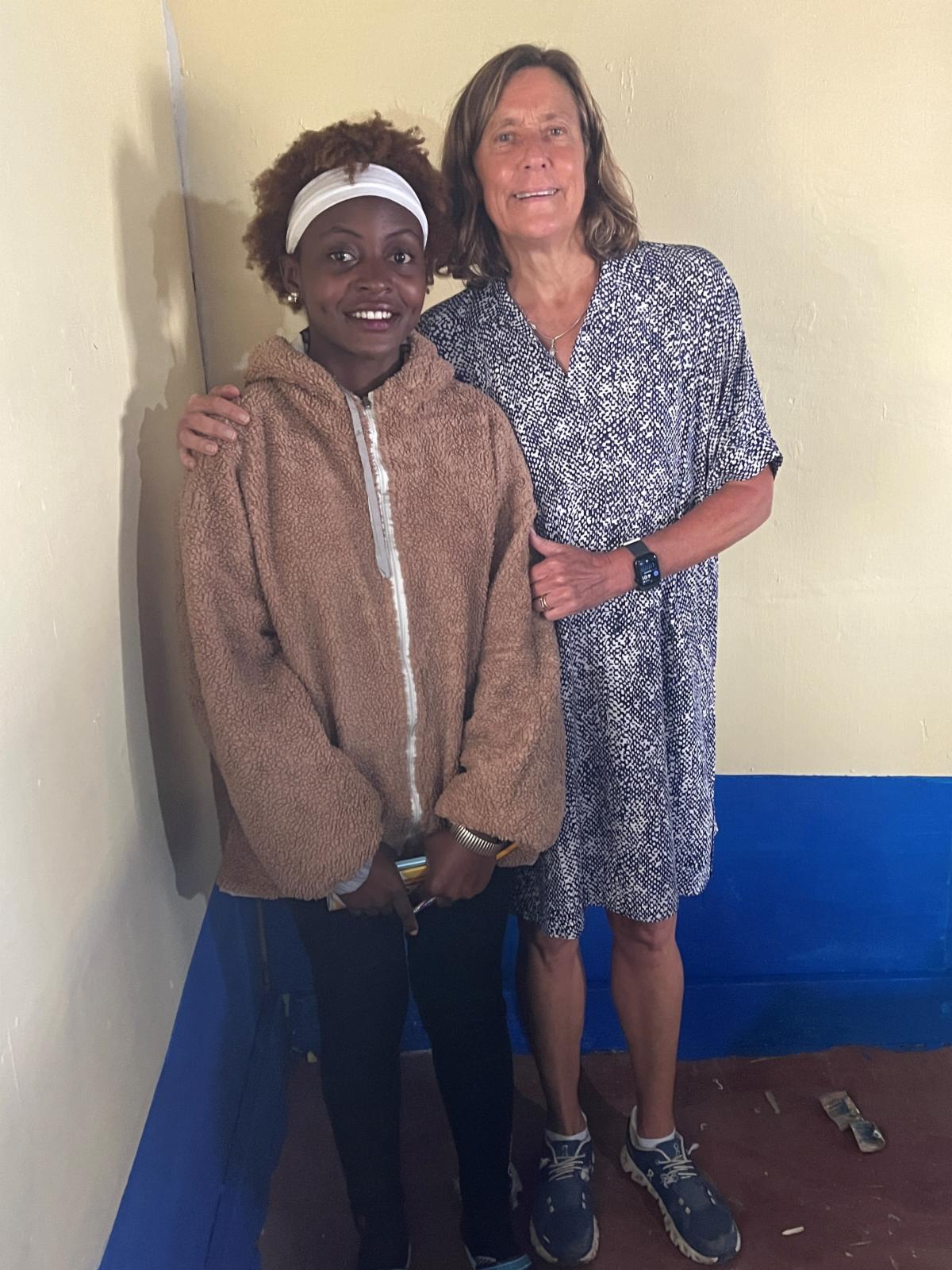
Christine & Mary, July 2024
Asante. Kiitos. Tack.
The joy in the smile and the hug that greeted me reflected so much more than the words she spoke. Thank you for being here again. Thank you for remembering me.
This was more than thank you. It reflected true gratitude from Christine, a beautiful young woman I first came to know about eight years ago when she was in middle school at one of our mission partner, Crossing Thresholds’ schools in the Kibera slum of Nairobi. Except for COVID years, I spend time with Christine each time I am in Kibera. I took her on her first trip out of the slum to high school (almost all high schools in Kenya are boarding), where for the first time, she had her own bed, her own pillow and blanket and towel, albeit on the top of a triple deck bunk bed in a crowded dorm room. Christine still lives with her mother and siblings in Kibera, but she has a scholarship to University and travels two hours each way on a rickety bus to attend classes. When she returns to Nairobi, she works as a sous-chef in a restaurant downtown until nearly midnight and then has to make her way through the dark alleys of Kibera to get home. When I asked her if she needed anything, she said, “no, just sit with me to talk. And maybe if you can, help me to find a quiet place with a light to study”.
Soon after our children begin to speak, we teach them to say thank you. But I wonder, do we go on to foster a true sense of gratitude?
Gratitude is a precious gift. It is hard to understand why some of the poorest people on earth are the most grateful or why those who are blessed abundantly often seem the least satisfied with their lives. Gratitude makes life easier for those on earth who struggle the most, and it makes life infinitely richer for those to whom much has been given.
In his beautiful book, Consolations, David Whyte writes, “Gratitude is not a passive response to something we have been given; gratitude arises from paying attention, from being awake in the presence of everything that lives within and without us…Thankfulness finds its full measure in generosity of presence…We sit at the table as part of every other person’s world while making our own world without will or effort; this is the essence of gratefulness, seeing to the heart of privilege.”
Each time I travel with Crossing Thresholds to work with children in the Kibera slum of Nairobi, I am overcome both by their poverty and by their gratitude. The children rejoice that some of us return to be with them year after year. They rejoice to meet new friends like Judy Foley and Phia Primps who traveled with us in July. They are grateful for a touch, a hug, a new pencil or crayon, for the gift of being seen. Every year in Kibera, it breaks my heart, and it renews my faith in humanity all at the same time.
Once our eyes are open to others’ pain and the struggles of their lives, the question becomes, what are we going to do about it? How are we going to live our own lives differently? What will we say in our prayers to a God who has given us so much and others so little? And if we are listening to the response, where is the Holy Spirit leading us?
A young social work student on our trip to Kibera asked Phia Primps and me at dinner one night: “How do you believe in a God who allows such poverty and injustice as we see in Kibera while we sit eating until we are full”? It is a hard question. But I think Jesus gave us a clue in each of the Gospels when he sent out his disciples to “proclaim the kingdom of God and to heal” (Luke 9:2). Jesus was asking his disciples, as I believe he asks us, to continue the work he began of healing and feeding and caring for people who are hungry for our love.
So perhaps the best way to teach gratitude is to model it in our own lives and when we can, to show our children the gratitude of those who struggle to be seen and valued, struggle for food to eat, clothes to wear, and people to care. May we greet every new day endeavoring to be Jesus in disguise to all those we meet as one way of showing our gratitude for the gifts we have been given, and may we send our children into the world to do the same.