


A few weeks ago, my Auntie Re died at the age of 89.
For 72 of those years, she was a Blauvelt Dominican sister. She entered the convent when she was just 17 years old. She made vows of poverty and chastity and spent the rest of her life trying to live them faithfully.
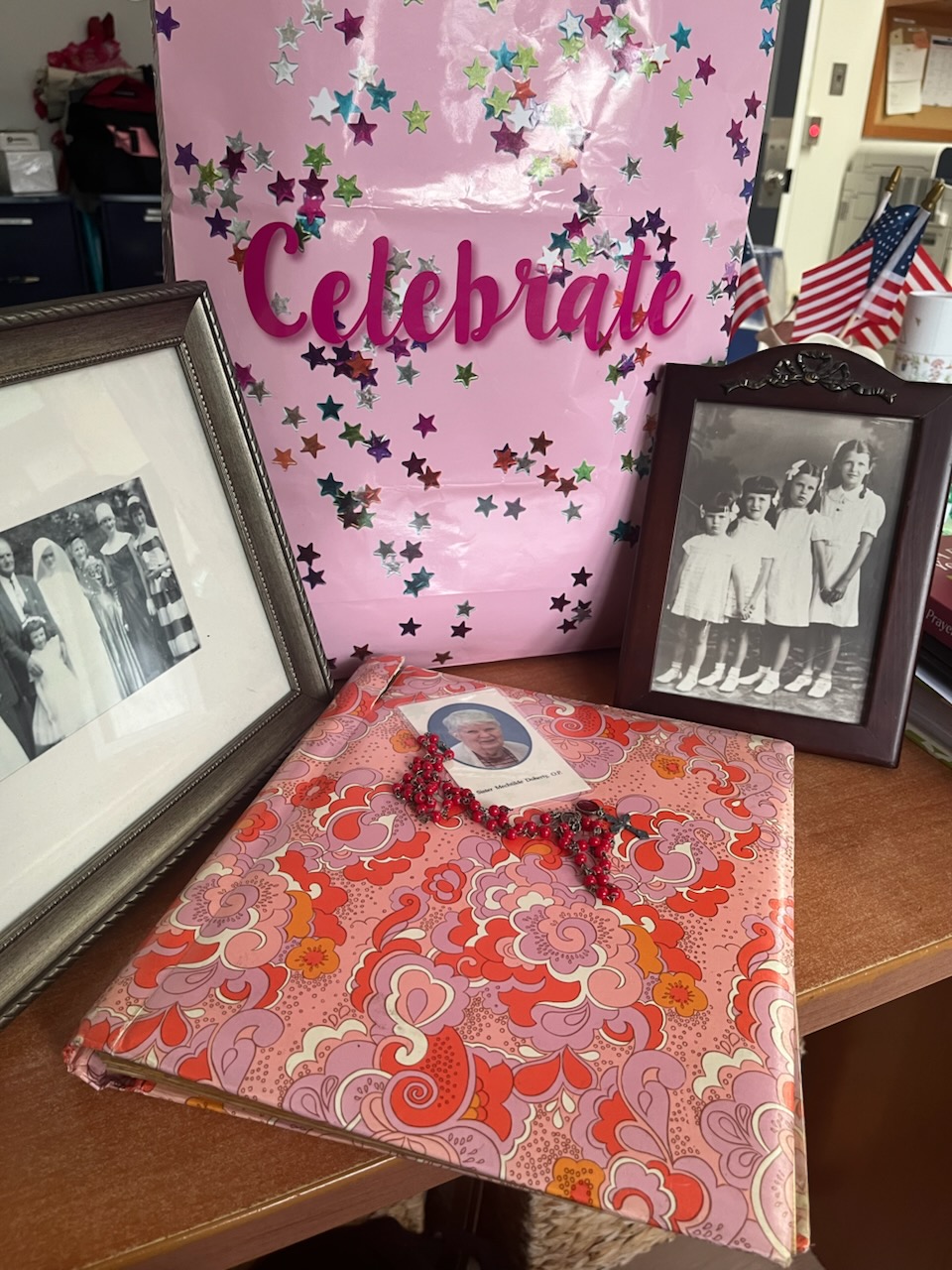
After her funeral, the head of her order handed our family a bag. Inside were my aunt’s personal belongings:
A miraculous medal.
A rosary.
Two picture frames.
A photo album.
That was it. All her earthly possessions, after 72 years of religious life, it fit into a bag. Her clothes had already been given to other sisters, including my Auntie Chris, who is 85 and still lives at the Motherhouse. There was no house to empty, no closet filled with things to sort through, no drawers of possessions accumulated over a lifetime. Just the bag. It is sitting in my office as I write this. I just can’t stop thinking about it.
My relationship with the institutional Church I grew up in has been complicated. There have been times when I have been deeply hurt and disappointed by the Church I loved, and eventually I made the difficult decision to leave because I felt that my relationship with the institution was beginning to interfere with my relationship with God.
But standing there at my aunt’s funeral, looking out at the women who remained, I felt something I hadn’t expected. I felt so sad. Not simply because my aunt was gone, but because I suddenly understood that I was looking at the remnants of a generation of women who had profoundly shaped me. These were women who had influenced who I became. They helped form my theology. They taught me about prayer and service and sacrifice. They taught me, long before I had the words for it, that faith was not simply something you believed. It was something you lived. They were not perfect women. None of us are. But they tried. They tried to live the Gospel in the middle of ordinary, messy, very human lives. They taught thousands of children about God. They cared for one another. They worked. They prayed. They showed up. They gave their lives to something beyond themselves. They were, in the truest sense, women for others. And perhaps that is what made the bag so powerful to me. Because there was so little in it, and yet my aunt’s life contained so much. Her legacy will never be measured by what she owned because she owned almost nothing. It could not be measured by the size of her house or the things she accumulated or the material evidence of a successful life.
Her life was measured in people. In children she taught. In people she cared for. In prayers she offered. In the notes and cards, she wrote to so many people. In the women with whom she shared a lifetime. In the people who were somehow different because she had been part of their lives. And in me. As I stood there giving her eulogy, I found myself wishing I could bring my own congregation into that room. I wished I could introduce you to these women. Not because I think everyone needs to believe what they believed or live as they lived. Not because I want to erase the very real problems and wounds that can exist within the Church. But because I think there is something these women have to teach all of us. Something universal. Something bigger than denominations and institutions and the ways we sometimes divide ourselves over what we believe. They knew something about giving your life away. They knew something about choosing people over possessions. They knew something about prayer and work, about showing up every day and doing the next thing that needed to be done. They knew something about living a life directed toward Christ rather than toward themselves. And perhaps most importantly, they understood that faith is meant to be lived and shared.
You should be able to see it in the way we treat people. You should be able to see it in the way we spend our time. You should be able to see it in what we are willing to give up and what we are willing to give away. You should be able to see it in the way we love. I don’t know what happened to all the things these women taught over the years. I don’t know where all the photographs are or where the stories will eventually live. I don’t know who will remember the small things they did every day that nobody ever applauded. But I know what was in my aunt’s bag and for as long as I live, I will never, ever forget it:
A rosary
A miraculous medal.
Two picture frames.
A photo album.
Somehow, that little bag feels like a sermon to me. Because when her life was finished, almost everything she had could be carried away in one hand. But everything she had given could not be carried away at all. It lives in the people she loved. It lives in the children she taught. It lives in the women who walked beside her. And, whether I realized it or not, it lives in me. Maybe that is what I was grieving as I stood there. Not simply the loss of my aunt, or even the loss of a particular kind of religious life. I was grieving the possibility that we might forget what these women knew. That a life does not have to be large to be holy. That faith does not have to be loud to be powerful. That a person does not have to accumulate much to leave an enormous inheritance. And that perhaps the most important things we can leave behind cannot be put into a bag at all. They are the things we have planted in other people. The faith we have awakened. The love we have given. The example we have lived. The people we have helped become who they are. My aunt left with almost nothing. And yet she left me with more than I could ever carry.